Have a headache, take an asprin. Upset stomach – chew some tums. Dirrahea – down some pepto bismol. There are lots of remedies people resort to. Sore muscles? I’ve come to believe that people think they have to muscle through that pain – it’s a sign of working out hard. NOT. There are treatments and things you can do to help soreness and muscle tightness that, lets face it, as we age, does not go away like it used to. What are some of these treatments?
EPSOM SALTS
Lately I have been reading about the power of Epsom Salts which makes me feel like I knew something that most people didn’t – I’ve been bathing in them for years. Two cups of Epsom salts in each bath – 3 times each week. Wow – that’s a lot of Epsom salts but check out the benefits. Rich in magnesium and sulfates, these crucial ingredients are both readily absorbed through the skin and into the body’s blood stream. Magnesium helps to improve muscle and nerve function, reduce inflammation and improve blood flow and oxygenation throughout the body. Sulfates are necessary building blocks for healthy joints, skin and nervous tissue.
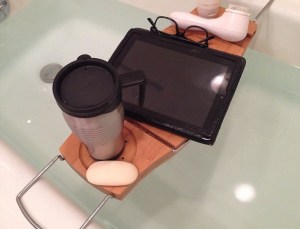 The use of regular Epsom salt baths has been shown to improve the symptoms of many health conditions including athlete’s foot, gout, toenail fungus, sprains, bruises and muscle soreness. It is also good for anyone dealing with chronic disease or chronic pain to do regular Epsom baths to help detoxify and de-inflame while improving mineral and sulfur balance in the body. In other words, if you are training for a bike ride, a distance run or if you need to rejuveniate after a particularly hard work out – try the “salts”. No more than 10 minutes is needed three times a week to experience the benefits. I frequently hear that people have no “time” for soaking in a bath, but let me tell you, it’s the best remedy to remove stress. I soak in the morning, but could just as easily at night. My daughters gave me a little stand that goes over the tub, and I place my tea on it, along with my ipad where I can check work emails, get my daily news, and read some chapters in my book.
FOAM ROLLERS AND ROLLING BALLS
Foam rolling, known as “Self-Mofascial Release”, applies pressure to specific trigger points on your body which aids in the recovery of muscles and assists in returning them to normal function. Normal function means your muscles are elastic, healthy, and ready for your next workout. Trigger points are knots that form in muscles after exercising. I like to vision my sore muscles as a ‘rubber band ball” that need to be rolled out so they are as smooth as a flattened pizza crust. Warning – this can be a somewhat painful experience, but it really does hurt so good. Once you start rolling and feel the knotted muscles loosening, it’s a pain that you know is good pain – like a rolling pin stretching out a ball of cookie dough. It’s like getting a free massage on a daily basis.
I have a large foam rol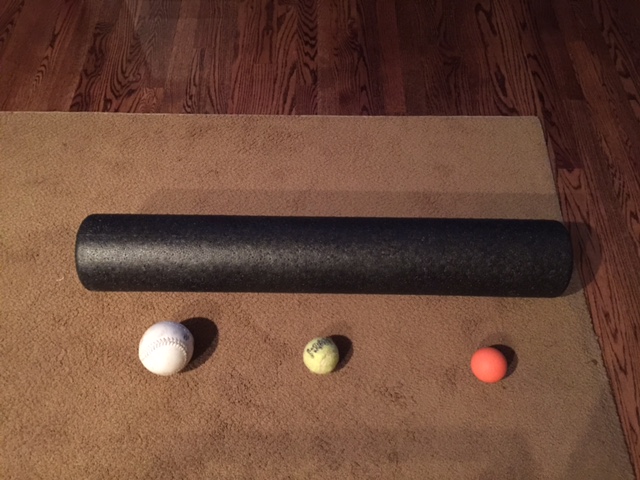 ler, a small tight “Yoga Ball”, a tennis ball and a softball and I rotate using all of them. If you don’t have a foam roller, you can start by using a regular tennis ball and softball that you probably have in the garage. The foam roller covers a larger area on your body and the smaller balls really zero into the tight knots. With a foam roller, you can control how much pressure you apply to the tissues that you’re working on, and you can locate and focus on areas that are problematic. Using the smaller balls for me is sometimes more effective as it works around the problematic area through deep pressure work creating a more intense stretching of the muscles and ligaments around the affected joints.
Foam rolling can easily been incorporated into your day. I generally roll at night when I’m catching up on my DVR list. I always stretch and roll after exercising – always. Rolling can be done in as little as 10 minutes and the benefits will last a lifetime when done on a regular basis. If you commit to soaking in Epsom Salts and foam rolling, you will be surprised at how good you can feel after a rigorous workout.
 Life Experiences Add Up