Thoughtless Words

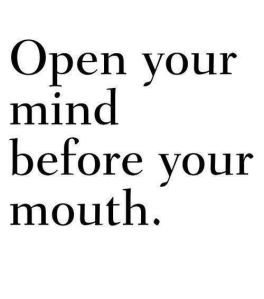
I was raised by a father who was big on bon mots and I think of his clever sayings often. Thoughtless words create sleepless nights is a good one, but the bon mot that comes to mind the most these days is the first and most profound of Don Miguel’s Four Agreements – Be Impeccable with Your Word.  This five word statement is easier said than done, but with today’s form of communication, it’s really not practiced at all.

I enjoy social media – it’s been great to reconnect with old friends, but what I don’t enjoy is that it tends to be word vomit for some without a thought of what they are really saying as they type away on a phone or computer.  I read hurtful comments to celebrities on Instagram and I am saddened – we have the instantaneous ability to spout out every feeling, opinion, and thought we have when we have them with no idea that there is a real person on the other end of the receiving line of which they truly know nothing about.  Snap judgments are made, and since comments are done anonymously,  those doing the commenting probably feel totally empowered to lash out, especially as they don’t have any consequences or even learn something from their behavior.   I am very hesitant to post anything rapidly without “being impeccable”  –  lashing out with angry comments and shaming.

The reason I bring this up is that as a human race, we are talking less.  We text and email, and chat online, with actual conversations going by the wayside.  So being “impeccable with your word” now seems to apply more than ever to the written word. Forcing opinions leads to arguments and damaged relationships. Debates can be seen as healthy arguments, but there is still a difference between discussing opinions and being intolerant to other’s values.

Our society has turned to a polarizing view on beliefs. Rather than trying to find a compromise, the new standard has become “my way or the highway,” ultimately causing destruction as we expect others to abandon their values. It’s important to realize that we must be tolerant of other people’s values and cultures, recognizing that no one has the right to force their way of life, or opinions onto anyone else.

Having an opinion is good, but being opinionated not so much.

To really master being impeccable requires that you heighten your awareness not just to the words you say, but also to the emotions you express, your attitude, your actions, and where you express the power of your belief. You have to develop a discipline of mindfulness to be impeccable in these expressions through out the day.  It is an art that requires constant attentiveness.

For me, I really have to think before I speak and write – I am one of those people who stress over things I say and the worst feeling is to feel regretful about that.  When I sit tight and remove the emotion from the situation, I find I am much better with communication – both oral and written.

According to the four agreements, your word (lower case) has to do with things you say – your opinions,  comments, and the thoughts in your head.  Your Word (upper case) has to do with the power you create through all the expressions that you make.  Being silent can be impeccable, whereas fears and spouting off do not make you impeccable.

Why is this important? I believe it leads to peace within yourself and ultimately, happiness.  Bitterness, anger, fear, judgement, and all the other negativity just makes you feel bad about yourself.  You can show yourself more love and compassion by not engaging in your thoughts that do not serve you well.  By not taking any comments personally, you can look at them for what they are, and feel compassion for the other individual with whom you might not agree with.  It makes life easier.
openyourmind


Eulogy for Robert Mitchell Fee

I wanted to eulogize my father at his funeral, but I couldn’t do it.   It was frustrating to me. Why wasn’t I able to stand up and talk about the most influential person in my life?   My heart was broken, and I was not emotionally available to anyone but my grief.  I wanted to speak words to everyone that honored him, and I was not capable of that at the time.

So here I sit – years later – ready to eulogize my father.  Time heals all wounds and my grief from losing him has subsided.  I realise I have been reflecting on my father more and more since he passed, and I am still continually learning from him and his life.  I see how truly wonderful and remarkable he was.  That has been time’s gift to me.  And the words are flowing – so here it is, my eulogy for my father.


Dad – how appropriate that I write this while listening to Handle’s Messiah.  I cannot listen to this and not think of you.  It brings back warm memories of Sunday dinners with the family – following church of course.  Each week was a new surprise – oysters rockefeller, turkey, and crown roast.  You always had a soup course – cream of mushroom, broccoli, chicken noodle and lentil. Desserts were classics such as baked alaska or cherries jubilee. Gravy was a must with any meat you served, and I remember standing on the step stool behind the stove watching you make gravy.  After your heart attack in the 70’s Mom asked me to make the gravy since I would watch you make it every week.  It was an epic fail on my end of course since I never really followed how you mixed all the ingredients, rather I remained transfixed on watching you cook and basically doing my only job which was stirring the gravy.  We dined with lit candles each week using family Limoges china, said grace, and occasionally had to give a “report” on a book of the bible you picked for us.  The music selection was almost always Handel’s Messiah, but you did throw in many operas which of course you dissected to us aria by aria, plot by plot.

As I look back on it – those days were not about just cooking and the meal – they were about family, about taking those opportunities offered to us to be together and to experience the richness of life, the richness of all there is to offer.  That is what you wanted for us, and by doing just this, you upped parenting a notch.   You of course had the traditional parenting quality of being the disciplinarian, but you were not the type of parent who chauffeured us around or even strived to be a friend.  To me you were a teacher of philosophy and led by example by being passionate in everything you did.  I think more than anything that is what you wanted to impart to all of us.  Sunday dinners exemplified your “The Sauce to the Meat is Ceremony” way of living.  This bon mote was one I heard frequently and one that I try to live by – make everything special.  Use the gifts you have to truly create memorable and enriching experiences for everyone.

When I encountered difficulty in my life, you simply said – “Robin, you have to choose how to live your life”, and proceeded to tell me to read Socrates.  That was the best advice anyone could give and light years ahead of where I was – simply that what I do, I choose. We have one life and it is up to us how to live it.  I cannot think of a more loving way to help your child than that. And yes, I still read Socrates.

Your desire to share all that you were curious about revealed what a deep thinker you were. I never thought you were pontificating, rather you wanted us to think deeply on these things, to live above the surface of life.  Keeping the television in the basement and making us stay home on Sundays really deepened my love for conversation and books.  My friends loved to come over, just to hear you.  You dissected poems to us like Ozymandias by Percy Shelly, and Daffodils by William Wordsworth.  The poems meant something to you and oh how you wanted to share those ideals –  things don’t matter, you can’t take it with you, let things go, beauty can be found by looking outside at daffodils, you can replace loneliness with joy and most importantly – nothing can overcome time. You read to us about the pyramids in Egypt, the statues on Easter Island, and talked about your world travels. Listening to your thoughts on Joseph Campbell and the “Power of Myth” influenced my life greatly  – those six components of myths that tell us about our lives have been instrumental in my own life.

How you loved our mother – what a gift to all of us.  I remember one moment during a lunch we were having when you cupped her chin in your hand, turned her head to all of us at the table, and said “Isn’t she the most beautiful woman in the world?” That simple gesture is one I think of often and the love you felt for her was never more evident than in that moment.

Your “there is nothing more important than family” comment – what a gem and one that I share with my daughters over and over again.  And guess what – it works!   I heard this growing up countless times.  It was all about respect for one another.  “Thoughtless words create sleepless  nights”, “don’t let the sun go down on your anger” –  all solid bits of advice to maintain openness, honesty, and a loving relationship with one another.  At our family reunion last summer, with all sixty-two of us running around, visiting with each other, toasting the family and truly enjoying each other’s company – I felt your spirit.  We are the collective consciousness of your life and we all feel so special for it.  I looked around our gathering room and felt that feeling trickling down to every child, every grandchild, and I hope great grand child.

You were a wonderful father and a truly remarkable human being, and I want you to know that wherever your spirit goes – it is in all of us.  That is due to you and I will feel forever grateful and blessed to call you my Dad.   Follow your bliss, do what makes you happy, be a healthy, wealthy follower of God, it’s a great day in the Boy Scouts today, neither a borrower or lender be, learn how to give and accept graciously – all good things that I heard day in and day out. These are the intangibles that are critical to how I life my life and the most glorious takeaways a parent can give to a child.  Truly.

I end with a quote, of course!  Again – during a very troublesome point in my life, you gave me a book that your mother had given to you, called “You Try It”.  Each chapter in this book is how I feel you lived your life – try putting first things first, try facing the wind, try faith in problem solving, in a plan, in action, in healing, in prosperity and always give yourself a personal check-up.  By practicing the presence and magnifying the light  – you release the real self.

You will know and so will those around you when you have found what you are looking for.  The psychologist says that learning is the reorganization of experience and behavior.  You Try It.


Mother Nature

JordyMeCanyonsCropped

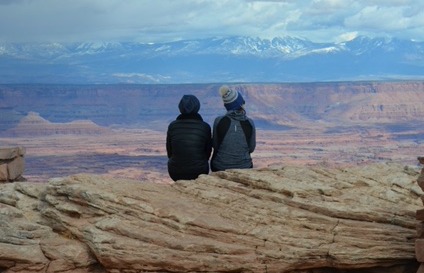
What is it about being in the great outdoors and absorbing the beauty that we are presented with –  the beautiful land forms, structures, mesas, sunsets, rivers, lakes, streams, and mountains?  It is the feeling of peace.  Our National Parks system, containing public lands and encompassing remote areas, delivers that peace in a major way.  There are no highways running through the ecosystems with cars barreling by, no strip malls, Starbucks, and office parks. I think all of us deep down crave this nourishment that the National Parks deliver.   Time enough outside helps us to connect with nature in an intentional way – these experiences are a doorway into this connection. When you notice even a tree, a small wildflower, or a majestic canyon,  you become aware of the presence of nature as a whole. These magical moments that you don’t prepare for, can creep up on you and fill your soul. You feel that Nature is not just a collection of trees and rocks and animals, but is a presence unto herself, and you are part of it.  These are the deliverable goods that our National Park system renders.

I am finding, however, that these experiences are becoming a thing of the past, not irretrievable but something that requires a concerted effort to produce.   There are hordes of people who want to have that same experience as you,  who are seeking the comfort that only a stunning canyon, a vast mountain range, or a dense forest can deliver.  As individuals cram for this precious time, a competition beings to develop between us which causes the stress to creep in – what time should we go to the park – can we get there first before anyone else – will there be enough parking?   This turns what should be an enticing day into a logistical nightmare.  It’s no different from lining up for concert tickets, or arriving at a good restaurant early just to get a good seat.

I had a similar experience while hiking in Utah at Arches National Park.  We specifically avoided Arches during the day due to the crowds of visitors.  We pulled into the park around 5:30 pm, looking forward to a less crowded late afternoon/early evening hike accompanied by a gorgeous sunset.  While hiking towards delicate arch,  as we marveled at the stone structures in the distance, we couldn’t help but notice the line of people hiking up the steep incline towards the rocks.   We made it up the trail to the delicate arch, and while there were probably only 40 people up top, we had to wait in line to take a picture of us standing beneath it.  I tried to experience solitude and beauty and drink it all in, but I had to actively tune out a theme park type noise – people laughing, running around, and yelling “Take my picture – I’m under the arch!”  I was happy to be there but it took a concerted effort on my part to appreciate all the beauty I was seeing.  I felt it was compromised in some way by people.

After Arches, we purposefully sought a more obscure hike at Horseshoe Canyon. Annexed into the Canyonlands in 1971, the canyon is a 2 1/2 hour drive from the entrance to the park, with 30 miles of dirt roads.  The hike was nine miles roundtrip with a steep descent and a steep climb back up at the end of the hike.   What made this hike special was that there were just a handful of us scattered throughout the trail.   Words cannot describe how peaceful and tranquil the afternoon was.  We didn’t talk much, and heard the sounds of running water, the wind through the trees, and the call of the Black Throated Gray Warbler.  We marveled at the rugged piñon pine growing out of solid slick rock, meandered through the breathtaking deep canyon that literally dropped suddenly out of the desert, and hiked aimlessly along the riverbed while gazing at magnificent sandstone spires and cliffs.  We just stared at the petroglyphs in total silence, and had a picnic lunch under these stone structures which house these drawings that go back 3,000 years.  We had time to commune, we had time to let the beauty of the place sneak up on us and envelope us with awe and wonder.  This was the experience I craved, and so worth our efforts to find it.

In 1916, when the National Park Service was created, there were a dozen national parks, visited by 326,506 people. Today, 412 parks cover more than 84 million acres and last year were visited more than 307 million times last year.  Some of the most congested places — Zion,  Acadia, Grand Canyon and Yosemite are seeking solutions for the overcrowded conditions with visitors to park their cars near the entrances and tour the park in shuttle buses.  Other approaches to limiting daily visitors, from increasing entry fees or requiring reservations, have been implemented, and I have been told that Arches National Park is considering a lottery  for park entrance tickets.  All these policies, should they be implemented, will have to be balanced against the founding idea that these parks exist for the public’s benefit and enjoyment.

President Roosevelt, who created the National Park System on June 8, 1906, stated that “places like Yellowstone must also be “preserved,”  for our “children and their children’s children forever, with their majestic beauty all unmarred.”