Common Courtesy

Lately I have been frustrated at people who do exactly what they want, regardless of how their actions affect others.  Certain people must feel exempt from rules that have been spelled out, or ignore what is common courtesy.  While in Yosemite, I witnessed people walking on the part of the trail where there was a sign clearly spelling out “do not enter – protected wilderness area”.  I watched National Park “tourists” climb on slippery rocks, all the while ignoring the danger signs –  signs worded with such gravity as “death can be a result of rock climbing”.   I sat in front of someone at the ballet who was crunching away on potato chips, and I sat behind someone who, ignoring the comments made by the artistic director to “not use flash photography or phones for videos”, go ahead and do just that – video most of the performance and snap away with their camera.  I was unhappily forced to listen to someone’s dance music while on a breathtaking hiking trail, noticing that their phone was on speaker in an outside backpack pocket, and just this past week I sat in the quiet car on my train ride home from work, as the person next to me chronicled her whole lousy day with a friend while on her phone. Such circumstances as these are examples of people being rude and exhibiting a general lack of common courtesy.

This is not a woe is me tale, rather circumstances that I believe most of us find ourselves in every now and then.  It’s the consequences for us collectively that we are forced to deal with.  Think of what these random acts of rudeness create?  People climbing all over the rocks near the waterfall in Yosemite ruined any photo you could possibly take.  Sure – they had their selfie with the waterfall cascading behind them, but those of us taking photos could not capture the majestic landscape without them in the picture!  Ballet is just as much music as it is dance, and most of the first act I was accompanied by crackling paper and loud chewing.  People do actually need a break from their daily work lives, and quiet cars on trains are designated just for that reason – quiet!  We don’t need someones bad day splayed out for the whole world to hear.

In instances like these, I would like to see the “what goes around comes around” notion prevail, but that is wishful thinking.   Rude behavior will always exist, and it is futile to think otherwise.  We have zero control over how people choose or not choose to behave.  You can lay the groundwork for your children, but as for strangers – good luck.  I remind myself that rude behaviors exhibited by others are not about me, but about those who see themselves as special or entitled in some way, with a possible underlying reason being a narcissistic outlook about how the world should work for them.   It is not in their wheel house to understand that honoring another person’s  experience collectively is good for everyone and not just for the individual.

What I try to do when I find myself in these situations is to approach them with kindness for me.  Seething with inner anger, or being rude back, is unhealthy for anyone and it ultimately ruins your experience and for others who are with you.  It is hard when the rude behavior is in public because you have no chance of escape (sitting in a theater or on a train),  but don’t let it ruin your day.  While at the ballet, I chose to focus on my daughter dancing, and I was able to tune out the person behind me having his last meal.  To sit and fume is not the way to go.  I am not sure there are any permanent solutions to these issues, but I think acceptance that these circumstances can happen lessen your chances of being upset when they do.

As for me – those annoying behaviors are not my takeaways and I refuse to have them be so.  I will forever remember my daughter dancing, whirling and twirling as if on air, and I will forever view those waterfalls at Yosemite as nothing short of magical.  And remember – you can ruin someone else’s experience but being angry and lashing out.  We are all in this together.
rude-people-quote

Yoga Nidra

Yoga Nidra – heard of it?  Neither had I – until a few weeks ago.  My first time back to yoga since foot surgery, I decided to take it easy on myself and take an athlete’s recovery class. This class focuses on deep stretches and is helpful for those in rehabilitation, those who have an imminent athletic feat coming up (in my case, RAGBRAI), or for those who simply want to get in tune with their muscles by deep stretching.

The last 15 minutes of the athletes recovery class is a practice called Yoga Nidra. Yoga nidra, or yogic sleep, is a powerful meditation technique.  Resting in savasana (corpse pose), this meditation takes you through the five layers of self, leaving you with a sense of wholeness.   These precious fifteen minutes of Yoga Nidra are equivocal to one hour of sleep.

I was somewhat skeptical, and only participated in Yoga Nidra because I was taking the athlete’s recovery class.  I grabbed a bolster, placed it under my legs, closed my eyes, and settled in for this unknown experience.  The instructor explained that it is not unusual to move in and out of consciousness as the Yoga Nidra script is recited.

As I lay there listening to the rhythm of the script, I began to feel overwhelmed with emotion and fought off tears as I wanted to break down and sob.   What was going on? After the session, I waited for the class to exit so I could go up to the instructor and cry openly.  She told me it is not unusual for people to cry and she even heard someone scream out loud.

As I reflected on my experience, I realized the session offered me a space to explore what I needed in that moment and provided me with a window into myself.  It brought face to face what I need to overcome emotionally.  I had no idea I had these emotions, and yet coming to an honest space with these feelings, I realized that they are just below the surface of me and have been there all along – I just never created an opportunity to deal with them.

What emotions came rising to the surface?  My struggle with acceptance of myself, and my inability at times to acknowledge that I am doing the best I can do.  We all pressure ourselves to prove to the world that we are worthy, we pressure ourselves by comparing ourselves to other people, and we pressure ourselves to be happy.   Releasing those unhealthy emotions was so healing – it was like a tune up for the soul.

And do you know what?  I can say this proudly – I am damaged.  My body armor has many dents in it – trauma, mistakes, injustice, hurt, grief, and misfortune.  No one emerges from this life unscathed.  However, by acknowledging the damage that life can bring over the years releases it and opens up room for healing, room for acceptance.

I was overwhelmed (hence the crying) by how hard I am on myself and how I care way too much about things that do not matter.  These self destructive thought patterns take away from how valuable I am – how valuable we all are.  Beating ourselves up over very tiny factors of daily life ruins the moment and is equivocal to carrying around a sack of rotten potatoes – the rot chipping away at your self esteem bit by bit.  That is why I cried – by releasing all those sad feelings that were trapped inside of me was kind of like me giving myself a hug, and I found myself saying “it’s okay Robin – you are okay”.

I have since found myself craving the profound relaxation that this practice instills, and using the non-judgmental and secure atmosphere that yoga nidra provides as a window into my emotional self.  I can think of no better way to explore what you need in the moment, as well as an opportunity to work on releasing long-held emotions. It is sort of like taking out the garbage – do it!

We’re all damaged. Every single beautiful, stupid, precious one of us. Damaged, damaged, damaged.
Matthew Norman, We’re All Damaged

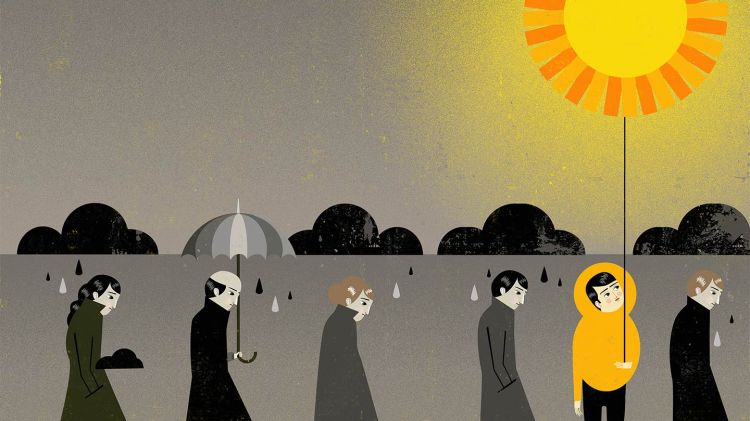
WHAT’S WITH THE WEATHER?

The weather – we live by it.  It rules our lives like an iron fist.   The weather affects the clothes we wear, the outcome of a planned event, and how our morning commute will go.  Weather is in charge of what we eat, how much we pay for food, and can ruin a perfectly planned outdoor party.  Weather fine tunes our bodies like a well oiled machine, giving us a tune up whether we want it or not both physically and emotionally.

I am home recuperating from foot surgery, desperate for a warm sunny day.  It’s May and still in the low 50’s.  This affords me zero opportunity to open the windows, feel the warm breeze while I write, or even to sit outside with a cup of coffee enjoying the garden view as I nurse my foot back to health.  I looked forward to being laid up with nowhere to go, and all the opportunity to enjoy Mother Nature’s late spring warmth and blooming early summer life.  Boy was I wrong.  I remained stuck inside on a cold, gray weekend, wearing long pants, a sweatshirt and buried under a blanket.   I was totally disappointed.

What is with the weather and moods?  I can feel a crappy weather day even when I’m inside.  It sinks into your skin.   It’s as if our physical and emotional bodies are our very own weathervane.  Not to mention my sinuses are killing me as the pressure drops – how can this be?

The relationship between physiology and meteorology is nothing short of fascinating. Our bodies are mostly fluid and gas pockets and bones, elements that make us interdependent with nature’s elements. Changing pressure systems in our bodies ebb and flow as fronts come and go –  lower pressure can cause sinus pain in those who live with chronic sinus pain (me).  This pressure can also cause achy bones and joints, and affect our blood flow.

Pressure affects joint pain in a fascinating way.  Every square centimeter of the human body has about 14.6 pounds of pressure on it and this constant pushing keeps us together. This pressure is always with us, and the slightest deviation can be felt in the suction cups called our knees, hips and shoulders. If pressure lessens, our joints start slipping and it’s time for some ice, an ace bandage or aspirin. You can literally feel a storm brewing.

There are many more heart attacks in the winter.  When you go outside in the freezing cold, your blood gets thicker and your blood pressure rises – creating the perfect storm for a heart attack.  Cold air also causes tiny cracks in lining of the bronchial tubing in your lungs which then swell and produce fluid. The expression “come inside and put a coat on before you catch a cold!” was referring to this process — there weren’t more cold viruses out in the snow that your grandmother was referring to, your poor lungs were just having a hard time with cold dry air. Flu viruses thrive in cold temperatures also, and we have an entire season named for the flu as a result.

The lack of sunshine when weather turns gloomy affects a gland in our brain called the pineal gland.  This gland is our internal sensor of light.  Once the sunlight is gone for the day, the pineal gland produces a hormone called melatonin that causes sleepiness.  As our bodies produce more melatonin, it produces less serotonin, which tend to make us crabby.

None of these little tidbits of facts help however, when we are faced with a gloomy weather forecast.  However, just stop for a moment and reflect on the unbelievable interdependence we have with everything that is going on around us. This can give pause for reflection, creating a more forgiving mindset where weather is concerned.

When faced with the challenging weather patterns we all experience, sometimes weather can be a state of mind, even if only for a little bit.   What to do about it?  Play reggae music, burn some incense, drink a margarita.   Eating summer foods can help  – fire up that grill for hamburgers and hot dogs,   Go outdoors – it gives your mental state a lift and tends to remove the anxiety felt by inclement weather.

weather and moods